
Rising temperatures, water scarcity, and increasingly unpredictable growing seasons are forcing agriculture to change faster than at any point in recent history. Farmers can no longer treat energy and land use as separate problems, they have to be solved together.
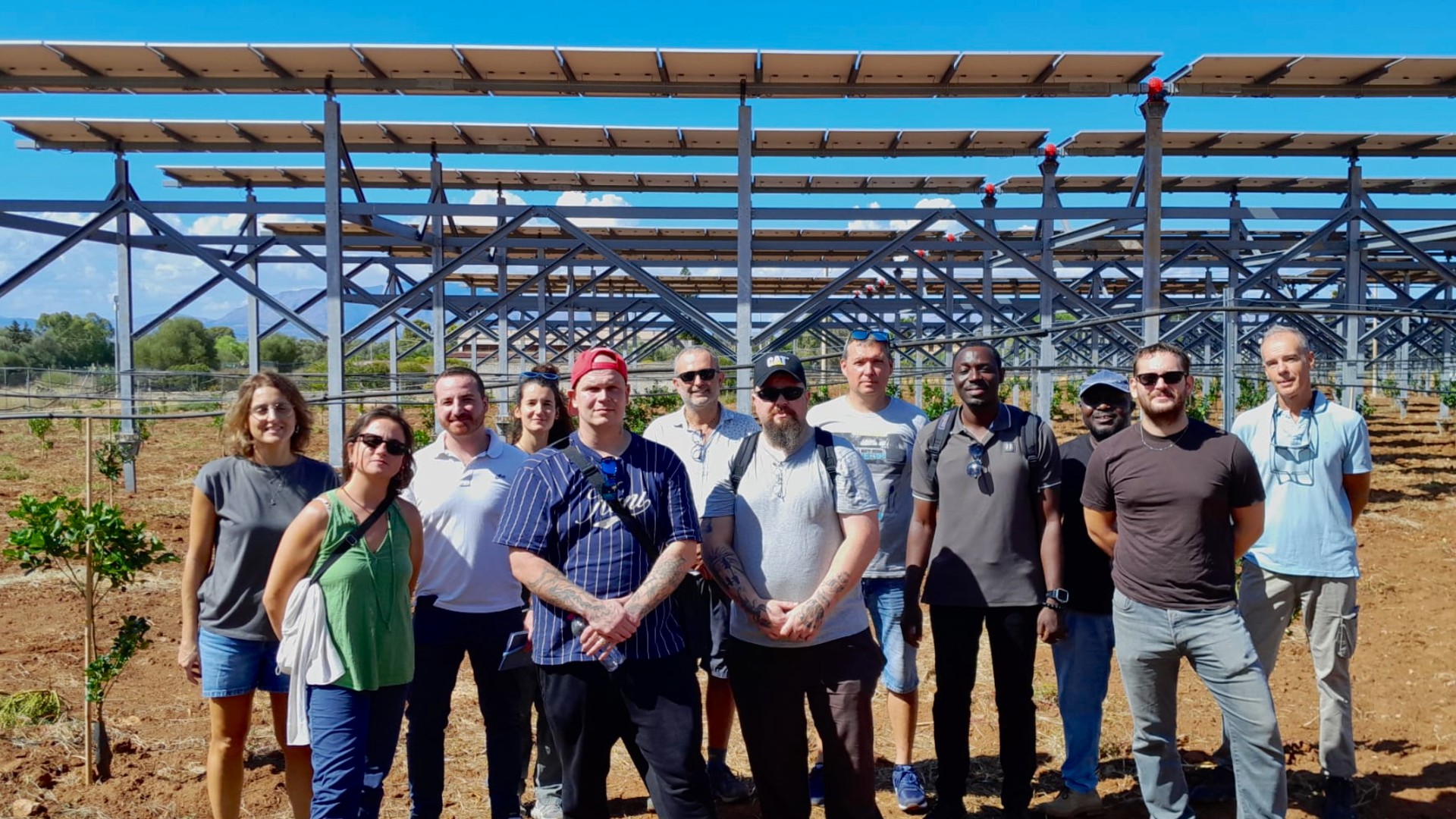
Last week, an international delegation came to Sicily to explore solutions to these challenges for three days of exchange under the EVECSA project.
Agrivoltaics as a real-world response
The visit opened with LAND Impresa Sociale's agrivoltaic installation, where solar panels and farmland share the same ground instead of competing for it. Participants reviewed ongoing research comparing lemon trees grown under the panels with trees grown in open fields, data that speaks directly to one of the central questions in climate-smart agriculture: can renewable energy production and food production coexist without one undermining the other.
Diversifying to build resilience
The group also visited Orto di Rosolino, where intercropping – growing different species together so they support each other – is used to cultivate tropical fruit with fewer external inputs. As growing conditions shift, this kind of diversification is becoming less of an experiment and more of a necessity.
The session also covered how Sicilian producers capture greater value across national and international supply chains, a reminder that climate adaptation has to make economic sense to actually scale.
Sharing best practices with Finland, Poland, and Ghana
Participants from Finland, Poland, and Ghana joined the visit alongside local Sicilian partners from CORERAS and the University of Palermo, for three days spent at Borgo Danilo Dolci, a place born from the legacy of the educator and activist for whom it's named, and today a center for open dialogue, non-formal education, and ecological innovation.
Bringing together such different agricultural and climate contexts is deliberate: the systems being tested in Sicily only prove their value if they can adapt to other regions facing their own versions of the same crisis.
The climate crisis isn't a future problem for agriculture, it's already changing how and where food gets grown. LAND's work on agrivoltaics and sustainable land management is one concrete answer to that shift, and exchanges like this one, testing the model against real partners from real regions, are how that answer gets stronger.