
When we talk about ecological transition, we often think of large-scale climate policies, advanced green technologies, or intense global strategies. But change does not only happen there. What if we shift our focus to an everyday, seemingly ordinary place, like a primary school? What if the school were surrounded by a real plot of land? What if ecosystem regeneration began right there, involving young people, teachers, and the local community in a concrete, shared, daily action?
Today, this question is far from abstract or negligible. With 80% of European habitats in poor condition and a biodiversity crisis directly affecting our well-being, it is increasingly clear that the solution cannot rely solely on technical interventions or spectacular projects. 1FAO (2025). The State of Food and Agriculture 2025. Addressing land degradation across landholding scales. What is needed is a profound cultural shift, capable of combining local knowledge, active participation, and a sense of collective responsibility.
Why start with schools?
The limits of traditional approaches
Until the mid-20th century, most of the world’s population lived in rural areas, maintaining a direct and daily connection with the land. In 1950, the rural population significantly exceeded the urban population. However, starting in the 1970s, this balance began to shift rapidly: according to United Nations data, the global urban population grew from about 0.75 billion people in 1950 to over 3.5 billion around 2015, surpassing the rural population for the first time, and is expected to reach 6.7 billion by 2050, while the rural population is expected to stabilize or decline. In Italy, this process has been particularly marked: today, about 78% of the population lives in urban areas. 2Kundu, D., Pandey, A.K., 2020, World Urbanisation: Trends and Patterns. In: Kundu, D., Sietchiping, R., Kinyanjui, M. (eds) Developing National Urban Policies. Springer, Singapore.
This shift has triggered rapid and intense urbanization, accompanied by a gradual reduction in direct experience with nature in everyday life. Today, people live predominantly in cities, in contexts increasingly mediated and distant from the natural systems on which they depend. Most importantly, these are the very systems from which humans themselves originate. In this scenario, land stewardship has progressively been delegated and technicized, becoming increasingly abstract relative to the daily lives of communities. Land has become an area managed marginally, rather than a shared process of collective responsibility. 3Salvini S., 2024, Evoluzione dell’urbanizzazione. Storia e sviluppo delle città nel mondo, Roma, Asterios Editore.Veron J., 2006, L’urbanisation du monde, Paris, La Découverte; trad it. 2008, L’urbanizzazione del mondo, Il Mulino, Bologna.
At the same time, urban green spaces have long been integrated according to a predominantly functional and compensatory approach, rarely recognized as living ecological infrastructures capable of generating environmental, social, and climate benefits. Environmental education has also been affected by this paradigm, often emphasizing knowledge transfer over direct, participatory engagement. 4Mancuso, S., & Viola, A. (2013). Verde brillante. Sensibilità e intelligenza del mondo vegetale. Firenze: Giunti.
Over time, this approach has revealed some critical weaknesses: environmental awareness is sometimes fragmented, community participation is not always continuous, and it is difficult to consolidate lasting changes in behaviors and daily practices. Yet, historically, the relationship with nature and trees has played a central role in shaping landscapes, cultures, and human coexistence. Cities, while hubs of aggregation, innovation, and services, have often developed by prioritizing other concerns, without fully integrating the natural dimension from which humans originate. 5Mancuso, S. (2019). Fitopolis. La città vivente. Bari-Roma: Laterza.
Rethinking the relationship between cities and nature is therefore not an optional choice, but a strategic necessity. Integrating nature into urban spaces — including through targeted reforestation — improves quality of life, strengthens urban resilience, and helps mitigate the effects of climate change. Above all, it recognizes green areas as an integral part of living spaces. 6Commissione europea (2020) Strategia dell’UE sulla biodiversità per il 2030: Riportare la natura nelle nostre vite. COM (2020) 380 final, Bruxelles (Belgio), 20 maggio 2020.
In this context, education plays a central role. Contemporary environmental challenges require the involvement of all sectors of society, starting with younger generations. Educating children about nature from an early age helps build the skills, attitudes, and practices necessary for concrete action. This is the key to rebuilding a profound connection between people, territories, and the future. 7ICLEI South Asia (2022) Guidelines for development of Miyawaki Forests in India. Prepared under SDC Supported CapaCITIES II project.
Education as a community benefit
This awareness gave rise to the Micro Forest Schools project, a European initiative that combines environmental education, biodiversity, and active community participation. The project is based on a simple but powerful idea: to create and co-design urban micro-forests in collaboration with primary schools, using them as educational, ecological, and social tools.
The micro-forests, inspired by the Miyawaki method, are small ecosystems with high biodiversity, planted with native species and designed to regenerate soil, absorb CO₂, improve air quality, and provide habitats for numerous species. Small in size but vast in transformative potential, especially in urban contexts where space is limited. 8ICLEI South Asia (2022) Guidelines for development of Miyawaki Forests in India. Prepared under SDC Supported CapaCITIES II project.
The capacity of a single tree to absorb CO₂ varies by species, age, and growth conditions. An adult tree can absorb roughly 100–250 grams of fine particulate matter and other pollutants per year, while also sequestering CO₂ through photosynthesis. [1] On a larger scale, one hectare of trees can capture tens of thousands of kilograms of CO₂ annually. Vegetation also plays a key role in reducing noise pollution: leaves, branches, and trunks absorb and diffuse sound waves, making urban environments — particularly schools — more conducive to children’s physical and psychological development. In this way, collective well-being improves through better air quality and microclimate regulation. 9Nowak, Hirabayashi, Doyle, McGovern, Pasher. (2018). Air pollution removal by urban forests in Canada and its effect on air quality and human health.
Connecting European territories
Micro-forestation also becomes a powerful way to connect the European countries involved in the project, each characterized by different climates, microclimates, and natural heritage. From the shady beech forests of Northern Europe to drought-adapted Mediterranean oaks and other species in the South, each territory contributes its own “ecological knowledge” and native species capable of supporting local biodiversity. In Sicily, for example, plants such as myrtle, laurel, Mediterranean pine, and holm oak represent an ancient balance between nature and climate, while in Greece or Denmark, other species play a similar adaptive role in very different environments. 10Frison, E. A. IPES-Food (2016) From uniformity to diversity: a paradigm shift from industrial agriculture to diversified agroecological systems. IPES, Louvain-la-Neuve (Belgium), 96
This network of micro-forests, while rooted in local contexts, builds a shared vision: taking care of ecosystems means recognizing the interdependence between environment, community, and culture. The project promotes measurable environmental benefits, but also fosters an educational journey that teaches cooperation, patience, and respect for the natural rhythms that do not align with urgency or productivity. 11Fratini, F. (2023). The Eco-Pedagogical Microforest: a shared oasis of proximity. A cutting-edge project at the intersection of ecology, urbanism and pedagogy.
Why micro-forestation is also an educational and political choice
Integrating micro-forest creation into schools goes beyond traditional environmental education. It emphasizes that biodiversity is not an abstract concept, but something that can be nurtured, observed, and experienced daily. It also restores an active role to communities in land stewardship, strengthening a sense of belonging and responsibility.
The expected outcomes are significant: workshops and activities have already shown high levels of satisfaction, increased knowledge on biodiversity, climate action, and reforestation, greater recognition of the ecological value of urban micro-forests, and strong engagement among teachers, students, and local communities. 12World Health Organization. (2016). Urban green spaces and health: A review of evidence.
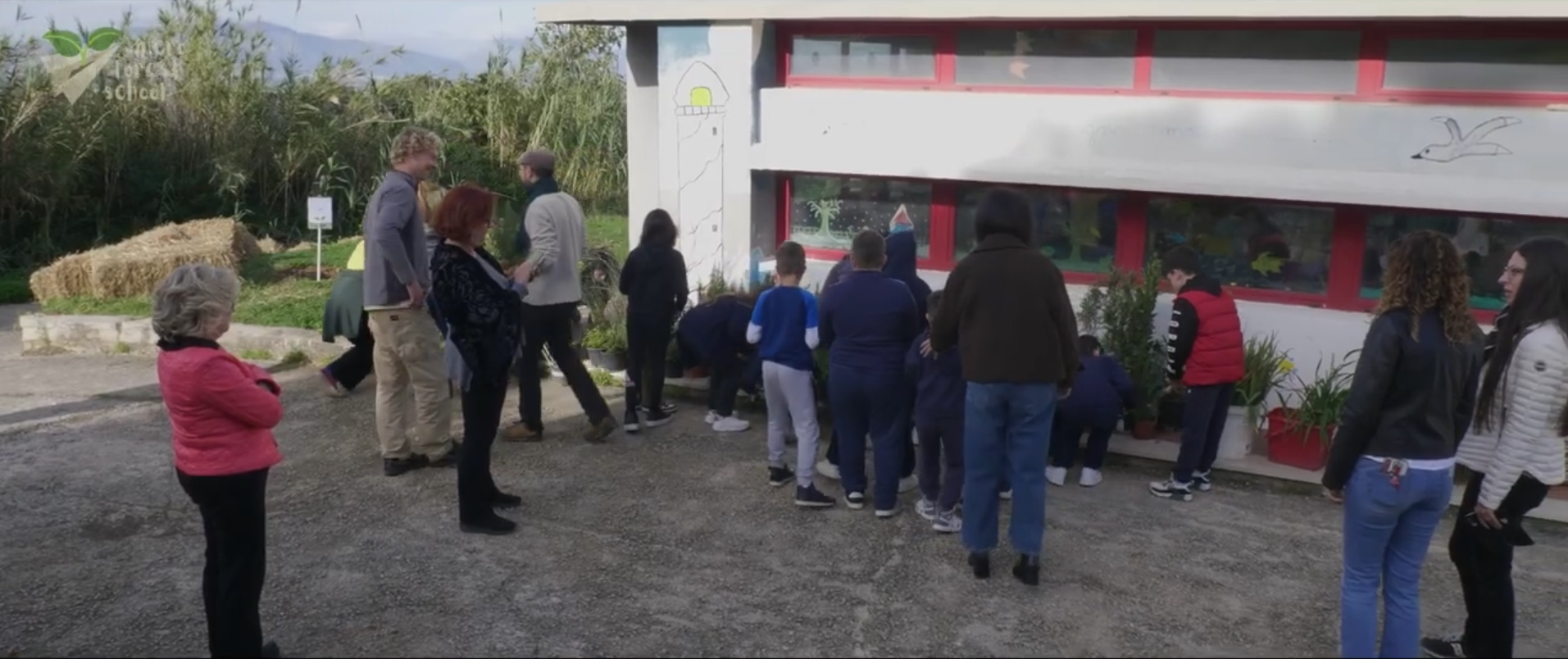
One of the most tangible and symbolically powerful results has been the creation and planting of micro-forests in partner schools. Young students, teachers, and the local community actively participated in soil preparation and planting of selected native species, transforming ordinary school grounds into growing ecosystems. The strength of this project lies in its educational process, which unfolds over time and makes the connection between learning and action tangible.
Watch the video of the planting day! It immediately illustrates the collective value of the experience — the first concrete sign of a journey destined to take root and grow over the years.
About Micro Forest
Micro Forest School is a European project funded by the Erasmus+ KA220-SCH – Cooperation Partnerships in School Education programme. For further information, contact Margherita Rosi: margherita.rosi@impresasocialeland.org.